


CONSULTING
Moving towards european digital integration in maritime transport
Lluís Miró
IT & Operations Consulting | Linkedin
How is it possible that, upon arriving in Europe, a ship coming from the other side of the world has to review the data to be sent depending on the country it is calling on?
Currently, crossing a maritime border in the EU means switching to a different digital language. This forces captains and consignees to duplicate their efforts by reporting the same information in different formats, depending on the member state. This structural disconnect acts as an invisible bottleneck for the efficiency of maritime transport and transparency of the supply chain.
To avoid this inefficiency, the European Community has been promoting the European Maritime Single Window (EMSWe) environment for several years now. EMSWe is a decentralized digital system established by Regulation (EU) 2019/1239. The EMSWe aims to harmonize and simplify mandatory reporting procedures for European ports by facilitating the electronic exchange of data between ships and competent authorities during calls, stays, or departures from ports in the Union.
It is estimated that the EMSWe will enable all Member States to save between €62 and €72 million annually, reducing the administrative burden and standardizing the data required to call at EU ports.

While data harmonization could save up to €72 million per year at the European level, it presents an unprecedented technical challenge for Spanish ports.
Each Member State can operate its Maritime National Single Window (MNSW) and connect it at the European level via the Reporting Interface Module (RIM), a standardized middleware. The Message Implementation Guide (MIG) has been developed for the messages, forms, and responses exchanged. It contains up to 60 formalities that aim to cover all obligations regarding the ship’s arrival, stay, and departure; crew and health data; and cargo data requested by Customs. These formalities originate from:
- EU directives or regulations, including customs formalities.
- Regulations of international bodies (e.g., IMO FAL Forms).
- Obligations depending on the legislation of each Member State.
There are three options for declarants (shipping companies, consignees, and port operators) to connect to the MNSW:
- MNSW web interface: users log in, create/edit scales, and upload information.
- M2M (system-to-system) interfaces: directly connect your internal systems to the MNSW via RIM, with uniform standards for interoperability.
- Excel templates: allow you to upload large volumes of data structured according to the harmonized format.
This flexible approach makes it easy to manage scale for small businesses using the web and large operators with automated integration, while maintaining data consistency.
From European standard to DUEPORT reality
In Spain, Puertos del Estado (State Ports), a public entity, must prepare and enable the MNSW, DUEPORT, so declarants can submit port call formalities. However, Port Authorities can choose to offer this service and connect declarants to the MNSW through their Port Community Systems (PCS). Some Port Authorities prefer this option because they already have a PCS in place. It ensures that all the valuable information they need to feed back into their PCS services arrives in the right form and at the right time. It also acts as a Single Window for port users. In any case, most Spanish ports face the challenge of adapting their legacy systems to the new MNSW requirements.
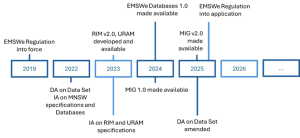
Although Regulation (EU) 2019/1239 was officially applicable as of August 15, 2025, an additional grace period of 18 months has been granted. This means adjustments will be made until February 2027. Most countries have reported technical delays and will continue implementation in 2026 by conducting tests and enabling coordination between authorities and sectors. It is generally expected that all European MNSWs will be adapted to the new EMSWe by the first quarter of 2027.
The EMSWe as a driver of transparency and sustainability
In short, EMSWe is a crucial step toward smart digitization of maritime transport in Europe. It provides:
- Create and edit scales with unique standards.
- Load harmonized templates (.xlsx) and reuse forms, histories, and drafts for scales in different member states.
- Homogeneous interfaces.
- Multiple connection methods for declarants.
The ultimate goal is to reduce administrative burdens and costs while enhancing transparency, efficiency, and sustainability in port operations. This will strengthen interoperability between the EU and international organizations, such as the International Maritime Organization (IMO).
In this changing landscape, the question for port authorities is not whether to adapt but how to do so as to emerge stronger. At IDOM Consulting, we are at the forefront of digitalizing maritime transport processes, helping ports make strategic decisions that will determine their competitiveness over the next decade. The future of foreign trade is digital, unique, and connected.