


CONSULTING
SAP Cloud ERP Private: Key strategies for leading the operational and sustainable transformation in Industry
Julio de Miguel Caleja
SAP Business Development Manager | Linkedin
The evolution of ERP systems has been a turning point in business management. SAP, the undisputed leader in this field, has spearheaded the shift to cloud technology with SAP S/4HANA, particularly with its SAP Cloud ERP Private solution. This article explores the key functional differences of SAP Cloud ERP Private and analyzes how these innovations are transforming business operations.
What makes SAP Cloud ERP Private unique?
SAP Cloud ERP Private is a new generation of cloud-based ERP designed to deliver flexibility and continuous innovation. For asset- and production-intensive industries, it is more than just a technical migration; it is a platform for digitizing the plant and supply chain with capabilities that an on-premise environment cannot match:
- Exclusive features and built-in improvements
-
-
- Centralized procurement and supply chain management: In sectors such as the automotive and manufacturing industries, the key is not just purchasing, but ensuring a steady supply. This functionality provides full, real-time visibility into suppliers, optimizing inbound logistics and ensuring that production never comes to a halt due to a shortage of critical components.
- Extended service parts planning: Advanced service parts management. For energy and mining companies, this is vital: it uses algorithms to ensure that critical spare parts are where they’re needed, drastically reducing unplanned asset downtime.
- Integrated business communication: This enables the automation of information flow between the ERP system and logistics partners or industrial customers, ensuring that any changes to a production order or shipment are communicated instantly and without manual errors.
-
- Sustainability and Regulatory Compliance
-
-
- Sustainability Solutions: Tools such as Green Ledger and Footprint Management enable companies to calculate the carbon footprint per unit of manufactured product. This represents a significant competitive advantage for Spanish industry, as it allows companies to certify the sustainability of their products to international customers and comply with European regulations on industrial decarbonization directly from the ERP system.
-
- Artificial Intelligence and Automation
-
-
- Joule and SAP Business AI: SAP Cloud ERP Private integrates Joule, an assistant that understands natural language. A plant manager or maintenance supervisor can ask the system, “What is the status of critical work orders for this week?” or “Analyze the bottlenecks on line 4,” receiving immediate answers without having to navigate through complex reports.
- Process automation: AI acts as a “digital operator” that can recommend preventive maintenance tasks based on historical data or automatically classify products for international trade, eliminating administrative tasks that do not add value to production.
-
- Continuous innovation and managed operations
-
-
- Mission-Critical Updates and SLAs: SAP guarantees an SLA of up to 99.99%. In industrial environments where the ERP system is the heart that drives the factory, this high availability ensures that operations are not disrupted by infrastructure failures
- Clean Core and Extensibility: The Clean Core methodology enables industrial companies to keep their ERP systems up to date without disrupting critical integrations with shop floor (MES) or design (PLM) systems. It maintains the standard for rapid innovation while allowing for the necessary extensions to support specific production processes.
-
On-Premise and Public Cloud: Flexibility for industrial environments
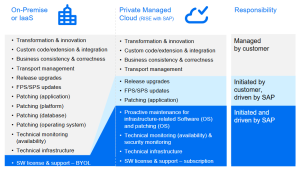
The choice of model is not just a technical decision; it’s also a strategic one that determines how our production capacity will grow:
-
- SAP Cloud ERP Private vs. On-Premise: While the on-premise model often stagnates due to concerns about disrupting complex customizations, the private edition allows industrial companies to maintain their specific manufacturing processes while leveraging the computing power and security of the SAP Cloud.
-
- Public Edition: Agility for lean operations. Ideal for regional warehouses or sales offices that do not require complex manufacturing processes and can quickly adapt to the standard.
One of the most powerful strategies we are spearheading at IDOM for sectors such as energy and automotive is the Two-Tier model:
- Manufacturing plants or generation centers run on SAP Cloud ERP Private, where they require robust processes, a high degree of customization, and full control over production.
- Sales offices or lean logistics centers run on SAP S/4HANA Cloud Public Edition, enabling rapid international deployment, controlled costs, and native integration with the “flagship” (the plant).
This hybrid approach enables the comprehensive, global governance of industrial data. It allows each facility to use the tool that best suits its operational needs.
Recent innovations and roadmap
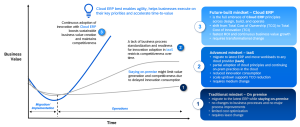
SAP Cloud ERP Private is not a static solution. It evolves to meet the challenges of Industry 4.0. The latest innovations focus on:
- Artificial intelligence applied to the value chain: Beyond chatbots, AI is being integrated into demand forecasting and logistics route optimization, enabling planning that is much more in line with market realities.
- Advanced Analytics and Planning (Business Data Cloud): This solution enables the integration of ERP data with operational plant data (OT). This facilitates the real-time consolidation of information from different assets and locations, which is critical for agile decision-making in sectors such as mining and energy.
- Smart Application Ecosystem: Industry-specific dashboards are available to monitor everything from energy consumption per production line to compliance with delivery deadlines from critical suppliers.
Life Cycle and Investment Security:
One of the most significant aspects of the current roadmap is SAP’s commitment to stability. The model calls for a new major release every two years, along with biannual functional enhancement packages (FEPs), which allow organizations to adopt new features without requiring large-scale upgrade projects.
Additionally, each version comes with seven years of standard maintenance, offering Spanish companies stability and a superior return on investment (ROI) compared to other traditional applications.
SAP Cloud ERP Private redefines ERP with exclusive features, continuous innovation, intelligent automation, and an advanced user experience. It stands out due to its ability to centralize processes, integrate AI at every level, ensure sustainability, and provide managed operations that meet the highest security and availability standards. Spanish companies’ experience and IDOM’s vision confirm that SAP Cloud ERP Private is the strategic choice for organizations seeking to transform their operations and prepare for the digital future.
As an SAP Gold Partner and a consulting firm specializing in implementation services, IDOM has led SAP Cloud ERP Private implementation projects in sectors such as energy, automotive, mining, manufacturing, and professional services. IDOM applies accelerated and preconfigured methodologies to minimize risks and maximize value for companies.