


CONSULTING
Why is your SAP strategy not sustainable without Clean Core?
FEBRUARY 28, 2024
Julio de Miguel
SAP Business Development Director at IDOM | Linkedin
Clean Core-based extensibility in ABAP is a forward-looking strategy, not just a technical recommendation. It enables organizations to evolve, innovate, and stand out in a changing environment without sacrificing the stability or maintainability of their SAP systems. Adopting these principles and models is essential for building a solid, flexible platform ready for tomorrow’s challenges.

Clean Core-based extensibility in ABAP is the key to innovating and evolving within SAP without sacrificing stability or upgradeability
Clean Core-Based Extensibility in ABAP: Definition and Principles
Digital transformation and the constant evolution of business models have made agility and adaptability essential to business competitiveness. The complexity of processes and the speed of disruptions require agile systems that can evolve without creating unsustainable technical debt. SAP has redefined extensibility in ABAP to align with the principles of Clean Core, ensuring ERP systems are resilient, innovative, and future-ready.
Clean Core is a holistic strategy that keeps the SAP system’s core as standard as possible. This allows extensions and customizations to be implemented in a decoupled and controlled manner. This facilitates the adoption of new capabilities, process automation, and continuous improvement without compromising the system’s stability or upgradeability.
Fundamental Principles of Clean Core and Working Models

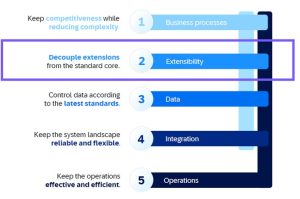
SAP has defined five guiding principles for Clean Core, which ensure that critical systems remain agile, efficient, and ready to embrace innovation:
- Decoupling extensions from the standard core: Customizations must be performed outside the core, using APIs and extension points released by SAP.
- Maintaining competitiveness by reducing complexity: Priority is given to extensions that provide unique value, avoiding unnecessary modifications to the standard.
- Landscape reliability and flexibility: The environment must be capable of adapting and scaling according to business needs.
- Data control in accordance with the latest standards: Data management must align with best practices and current regulations.
- Efficient and effective operations: System administration and monitoring must facilitate continuous improvement and risk reduction.
Similarly, extensibility in ABAP can be approached in two main ways:
- On-stack extensibility: Customizations made within the SAP Cloud ERP system itself, such as extending standard applications, creating custom fields, or automating processes using ABAP Cloud.
- Side-by-side extensibility: Development of applications and processes in SAP BTP, decoupled from the core, using technologies such as CAP, SAPUI5, and low-code/pro-code tools. This option is ideal for scenarios requiring integration with multiple systems, high scalability, or external access.
The choice between the two depends on factors such as integration with critical processes, rapid access to data, transactional consistency, scalability, and requirements for autonomy.
SAP has evolved the traditional Clean Core model for our ABAP developments by transitioning from a three-level to a four-level concept. This new model provides greater clarity and structure for decision-making regarding extensibility:
- Level A/B (Clean Core): Extensions implemented using the SAP Business Technology Platform (BTP) and ABAP Cloud, leveraging released APIs and extension points. They are upgrade-safe and scalable.
- Level C (Conditional Clean Core): Use of internal SAP objects only when Levels A/B cannot be applied, with a change log used to track the impact.
- Level D (Not Clean Core): Direct modifications to the standard or use of non-recommended objects, which generate technical debt and update risks. These should be avoided as much as possible.
Governance and Measuring Scalability
The key recommendations we should keep in mind and use to guide our ABAP team are as follows:
- Establish clear governance: Define guidelines for clean code and ensure commitment from all teams.
- Train and empower developers: Provide training on Clean Core principles and the new capabilities of ABAP Cloud and SAP BTP.
- Prioritize business value: Focus remediation efforts on the code and customizations that deliver the greatest impact.
- Monitor and continuously improve: Incorporate Clean Core measurement and improvement into regular development cycles.
- Adopt the “Boy Scout” principle: Promote incremental code cleanup with every change made.
Achieving and maintaining a Clean Core requires ongoing governance, ranging from the definition of functional requirements to the architecture, implementation, and deployment of extensions.
SAP has developed a comprehensive measurement framework, called the Clean Core Measurement Framework, which enables organizations to move toward Clean Core by assessing governance, maturity, and continuously tracking specific KPIs:
- Changes to the standard
- Percentage of code at each Clean Core level (A, B, C, and D)
- Percentage of unused custom code
- Technical debt score
- Impact on processes and operations
Quality Gates: Ensuring Quality and Compliance
Quality gates (Q-gates) are checkpoints established throughout the lifecycle of extensions and customizations, designed to ensure that each development adheres to the Clean Core principles before moving on to the next phase. Typical Q-gates include:
- Architecture Review: Verification that the proposed solution adheres to the A/B levels of the Clean Core model whenever possible, prioritizing the use of released APIs and decoupled extensions.
- Impact Assessment: Analysis of the potential impact on the standard, maintainability, and technical debt.
- Quality testing: Use of tools such as ABAP Test Cockpit to identify quality, security, and compliance issues.
- Deployment approval: Only extensions that pass all quality gates may be deployed to production environments.
These quality gates are integrated into the RISE with SAP methodology and can be monitored and managed using tools such as SAP Cloud ALM. This platform enables comprehensive management of the lifecycle of applications and extensions. It plays a critical role in the Clean Core strategy, as it provides centralized dashboards for viewing KPIs, as well as continuous management of the quality gates for each of our projects.
In summary
Maintaining a governance framework that keeps the core of our SAP Cloud ERP systems as isolated and standard as possible will enable us to continuously benefit from all the enhancements SAP releases. This reduces our implementation costs and update efforts. We can achieve this by implementing and measuring the Clean Core philosophy, as well as by using SAP Cloud ALM and tools such as ATC for monitoring and measurement.