


WATER CYCLE
Brine mining: when desalination “waste” becomes a treasure
OCTOBER 28, 2026
Eva Mur Ortega
Process Engineer & Project Manager | Linkedin
What if the waste we currently discharge into the sea were actually a liquid mine waiting to be tapped?
Each time a desalination plant produces fresh water, it also generates brine, a hypersaline waste product that can be twice as concentrated as the original seawater. For decades, the question has been the same: How can we dispose of it while minimizing environmental impact? Brine mining, also called brine recovery, turns this question on its head by asking, “What if, instead of getting rid of the brine, we extracted value from it?”

What if brine were no longer considered a waste product, but rather a valuable resource?
Recovering brine could turn desalination plants into liquid gold mines.
What exactly is brine mining?
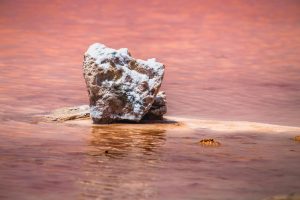
Brine mining, also known as brine recovery, is the process of extracting dissolved minerals and metals from highly saline solutions. These solutions are generated in salt flats, geothermal brines, and, of particular interest here, seawater desalination plants. The concept is straightforward yet ambitious: transforming an underutilized waste product into a valuable resource in line with the principles of the circular economy.
The context illustrates the magnitude of the opportunity. There are more than 15,000 desalination plants in operation worldwide, and most of the brine they produce is discarded. We are looking at one of the world’s largest and least exploited multi-mineral deposits.
Why now? The economy has changed
The economic equation has shifted. The production and transportation of conventional salt have increased its cost. Therefore, producing salt and minerals at the desalination plant is beginning to make economic sense.
Additionally, climate change is disrupting the salt and raw materials markets, reinforcing the appeal of brine mining as a potential future direction for desalination. Another contributing factor is the growing need for desalinated water, which results in increased brine production.
The result? A well-designed recovery of brine-derived products can offset a significant portion of the cost of desalination. According to various studies, this could amount to around 50% under optimal conditions and 65% to 90% of annual operating costs through the sale of products such as sodium chloride, bromine, and magnesium salts in sequential recovery scenarios.
In other words, brine could help cover the cost of water.
What minerals and products can we obtain? What are they used for?
Although most are found in very low concentrations, the oceans contain virtually all the elements in the periodic table. Only a few elements occur in significant quantities.
It is these elements that attract the most interest for this reason. The key lies in balancing volume, market value, and technical feasibility.
Broadly speaking, the sector distinguishes three levels:
High viability (those that combine value and volume)
-
- Sodium chloride (NaCl): the quintessential mass-market product, the foundation of the chlor-alkali industry, and used in a wide range of industrial and food applications.
- Bromine (Br): high profit margin; used in flame retardants, pharmaceuticals, and photography.
- Magnesium salts (Mg): showing a clear upward trend. Magnesium is lighter and stronger than steel and is critical for the automotive and aerospace industries. Today, its production is heavily concentrated in just a few countries, which also makes it a strategic issue.
Average interest
-
- Potassium (K): highly valuable as a fertilizer and, therefore, linked to food security.
Low traffic today, but under close watch
-
- Lithium (Li): the star of the media spotlight due to its role in batteries and energy storage. The challenge isn’t that it exists—it’s found in the ocean—but rather its low concentration and the cost of selectively separating it from sodium, magnesium, and potassium. That’s why its actual performance remains, for now, limited.
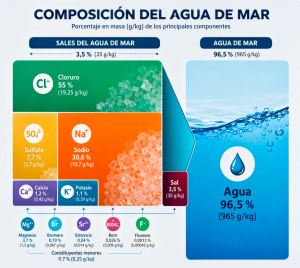
In addition to the materials on this list, the most advanced European projects include critical raw materials such as boron, scandium, vanadium, gallium, indium, molybdenum, rubidium, and calcium. Calcium is of particular interest because desalinated water becomes too pure and requires remineralization to be fit for human consumption.
Additionally, some processes are designed to generate reagents, such as sodium hydroxide (NaOH) and hydrochloric acid (HCl), on-site. The plant reuses these reagents, thereby reducing operating costs.
How is it done? A chain in four stages
Although the specific technology varies depending on the target compound, the process almost always includes four stages: pretreatment, concentration, compound recovery, and purification.
Concentration techniques, such as high-pressure reverse osmosis, sequential nanofiltration, and electrodialysis, bring the brine close to saturation. Next, selective techniques, such as membrane processes, adsorption, solvent extraction, or crystallization, separate the products.
The real bottleneck is usually not the chemistry but rather selectivity and combating fouling in membrane technologies.
It is worth mentioning the technological development of membrane processes, some of which are still in their early stages, while others are more advanced and specifically geared toward their application with brines. The challenge is always the same: brines are highly concentrated, so a step beyond conventional reverse osmosis is necessary.
The most notable technologies are:
-
- Ultra-High-Pressure Reverse Osmosis (UHPRO): operates reverse osmosis at pressures far higher than usual to further concentrate already saline streams.
- Forward Osmosis (FO): utilizes the natural osmotic gradient instead of pressure, reducing energy consumption.
- Membrane distillation (MD): combines membranes and a thermal gradient, with the advantage of being able to utilize low-grade waste heat.
- Osmotically assisted reverse osmosis (OARO): overcomes the osmotic pressure limit of conventional RO, allowing for higher recovery rates in concentrated brines.
- Electrically conductive selective membranes: designed to preferentially separate specific ions, which is key to recovering target elements with high purity.
- Bipolar electrodialysis (BPED): beyond separating ions, it allows for the in situ generation of reagents such as sodium hydroxide (NaOH) and hydrochloric acid (HCl), which the plant itself can reuse.
Beyond Minerals: Biological Recovery of Brine
The recovery process extends beyond the extraction of salts and metals.
The ALGASAL⁺ project, developed by the Canary Islands Institute of Technology in collaboration with the universities of Almería and Las Palmas de Gran Canaria, is an inspiring example.
The project involves cultivating native algae and discharging brine from desalination plants. The macroalgae act as a biofilter, absorbing nutrients and improving water quality before it is returned to the sea (a process known as bioremediation), while also generating biomass that can be used by the food industry or as an organic fertilizer.
In other words, the project turns waste into a resource while helping to protect the marine environment.
A European initiative with its own identity
The European Sea4Value project (Horizon 2020), involving 16 partners, has developed what aims to be the first industrially viable modular, multi-mineral brine mining process, with the goal of turning desalination plants into the European Union’s “third source” of raw materials.
To this end, various technologies have been validated in a moving lab installed at actual plants.
This knowledge has also led to a European standardization agreement (CEN Workshop Agreement CWA 18153:2024) on the recovery of minerals and metals from desalination brines, an important step toward the sector’s maturity.
At the same time, regions such as the Middle East, led by Saudi Arabia, are strongly promoting the industrial aspect of this activity.
Where does IDOM fit in?
At IDOM, we are closely following the shift from a linear model (“desalinate and discharge”) to a circular model (“desalinate, recover, and valorize”).
We believe the greatest value lies in the intelligent integration of technologies, such as designing hybrid plants, evaluating technical and economic feasibility, and supporting operators and developers in their decision-making processes.
For this reason, we aim to play an active role in the technological developments emerging in this field. We aim to collaborate with our clients, who are large desalination plants interested in exploring ways to recover value from their brine, as well as with equipment suppliers and technology partners on the design of pilot plants, the manufacture of prototypes, feasibility studies, and technological development projects within the framework of collaborative initiatives funded by the European Union.
We are making progress in the desalination sector. The future of water is about more than just producing water.