


CONSULTING
MCP: technology that transforms the software development lifecycle in the industrial sector
Juan Manuel Silva Hidalgo
Smart Industry Consultor | Linkedin
Those who have used artificial intelligence (AI) to create content know that AI can make mistakes. These errors, commonly known as “hallucinations,” can range from minor wording errors to incorrect answers that render the AI useless—or even dangerous.
This is even more problematic in software development and operation. Erroneous results affect the quality of the content and can lead to functional failures, vulnerabilities, faulty integrations, and poor technical decisions. We’ve seen this with the failure of multiple systems. As the use of AI in software development expands, it becomes essential to have control mechanisms that provide valuable context, clear boundaries, and controlled access to the systems with which AI interacts. The Model Context Protocol (MCP) aims to standardize interaction between AI tools and real development environments, making AI use more reliable while preserving its benefits.
At IDOM, we have integrated this technology into our software development processes and deployed production environments. In this article, we share our experience with this technology, the main challenges we’ve faced, and the benefits we’ve identified thus far.

The Model Context Protocol (MCP) allows artificial intelligence to be integrated into real-world software development environments in a controlled, reliable, and contextualized manner
What’s going on right now? Why do AI systems make mistakes?
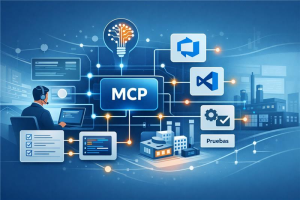
Although AI is being used more and more, we are currently only tapping into a fraction of its true potential. Many challenges must be overcome to transition from partial adoption to deeper, more useful, and more reliable integration into development and operational processes.
One of the main problems is accessing the actual project context. Currently, the most common way we interact with AI tools, especially large language models (LLMs), is through chat interfaces. This limits the ability of AI models to access crucial information, such as project architecture, business rules, direct repository access, work tickets, system dependencies, and the status of tasks within projects.
Another challenge is governance and control. In many production environments, the boundaries regarding the information AI can access, the tools it can use, and the actions it can perform are not clearly defined. This lack of control undermines confidence in AI’s use and introduces risks related to security, traceability, and operations.
MCP as the standard for integrating AI into real-world environments
This is where MCP comes in—a technology designed to standardize the connection of AI models with systems, tools, and real-world data sources. MCP improves interaction with AI and makes it more useful, context-aware, and controllable in both software development processes and the day-to-day operation of applications and solutions already deployed in production.
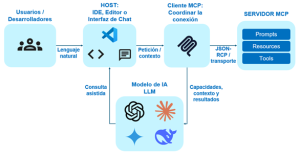
MCP operates on a host-client-server architecture. The host is the primary environment where interaction occurs. Examples include an IDE, an editor, or a conversational interface. Clients operate within the host and are responsible for communicating with MCP servers. Servers, on the other hand, are the systems that expose the model’s specific capabilities, such as access to project information, reusable instructions, and executable functions.
To achieve this, MCP organizes interactions into three main types of capabilities:
Prompts, which function as templates or instructions to guide the model through specific tasks. Resources refer to relevant project information that the model can access, such as files, documentation, diagrams, or data. Finally, tools are functions that the model can execute to perform a specific action within a controlled environment.
This framework’s value extends beyond accelerating development activities. It enables AI to play a more useful role in day-to-day operations such as consulting technical documentation, analyzing incidents, validating configurations, interpreting logs, providing user support, and updating information related to live solutions. Thus, MCP improves not only software development, but also its monitoring, maintenance, and evolution in real-world environments.
While all this information is useful, it remains somewhat abstract. Its value is much better understood in practice. Therefore, we will describe the process we followed to incorporate this technology into our development workflows and the results we obtained.
Testing the concept: MCP Azure DevOps and MCP Open Source Ignition
The first step in adopting this technology was identifying which tools we were using and how, as well as where there was room for improvement. Azure DevOps already played a central role in managing much of our software development lifecycle, so it was only natural to start there. Based on that assessment, we analyzed which AI capabilities were available and could be integrated into the Azure DevOps environment. We then discovered a significant advantage. Azure DevOps had a functional MCP server that easily integrated with our Visual Studio Code development environment, allowing us to quickly create an initial proof of concept.
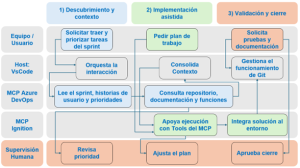
Connecting to the server was simple. We just had to add the MCP configuration in Visual Studio Code and log in with our credentials. This gave us controlled access to relevant, authorized project information. Using natural language instructions, we requested a list of all tasks associated with the current sprint and classified them according to importance. Then, we identified the highest-priority task based on the repository’s content and assessed existing features that could be useful for resolving it. With this single instruction, the AI could access user stories, consult functional documentation, and understand the technical and business contexts.
Based on that, we asked it to generate a detailed implementation plan, which included a review of the project’s existing design patterns, available APIs, and libraries. After generating the work plan, we reviewed its main points, refined certain aspects, and integrated tools from Ignition’s MCP Open Source, a software development platform geared toward industrial solutions, to support the implementation of the solution.
With the new code generated, we asked it to incorporate a set of tests and validations to verify the proper functioning of the proposed solution and its integration with the existing code. Finally, after the solution was approved, we asked it to generate the corresponding documentation and integrate it with the existing documentation to keep it up to date and aligned with the project’s current status.
Thus, the proof of concept demonstrated not only MCP’s ability to assist with specific tasks, but also its potential to support various stages of the software development lifecycle, from requirements gathering to implementation, validation, documentation, and change management via branches, commits, pushes, and pull requests, all through natural language interaction and human supervision.
Conclusions: What does the future hold?
Experience has shown that MCP is a significant technical improvement in how we interact with artificial intelligence and a new way to integrate it into real-world work environments. Its ability to connect models with context, tools, and systems reduces friction, speeds up tasks, improves the quality of solutions, and makes more effective use of accumulated project knowledge.
However, its scope extends far beyond developing new functionalities. In the short term, MCP can bolster the performance of existing solutions by supporting tasks such as incident review, technical information retrieval, and maintenance assistance. In the future, MCP could lead to more specialized applications, such as assistants for industrial process management. These assistants could support teams in monitoring operations, interpreting plant events, diagnosing faults, and verifying critical configurations. In contexts where operational continuity and secure interaction with real-world systems are critical, this type of evolution could make MCP especially valuable for building solutions with a broader reach.
Our experience shows that the value of MCP lies not only in automating specific tasks but also in enabling a more contextualized, controlled, and useful application of AI across various stages of development. Therefore, rather than viewing this technology as a future promise, organizations should identify processes where it can generate value today. They should start with controlled pilots and progressively build adoption that aligns with their tools, teams, and business objectives.