

Here’s how we use AI to predict the behavior of building façades
The façade is more than just form. It is the primary factor in determining how a building functions, including how light enters, how solar radiation is managed, and how comfort is perceived inside.
Every decision counts at that point. Decisions are being made earlier and earlier.
From May 19 to 22, Julia Gómez Goenaga participated in Future of Construction 2026 at ETH Zurich, where she presented research focused on the initial design stage.
Conducted in collaboration with the University of Navarra and the University of Florida, the study explores the use of artificial intelligence to predict the environmental performance of facades in real time.
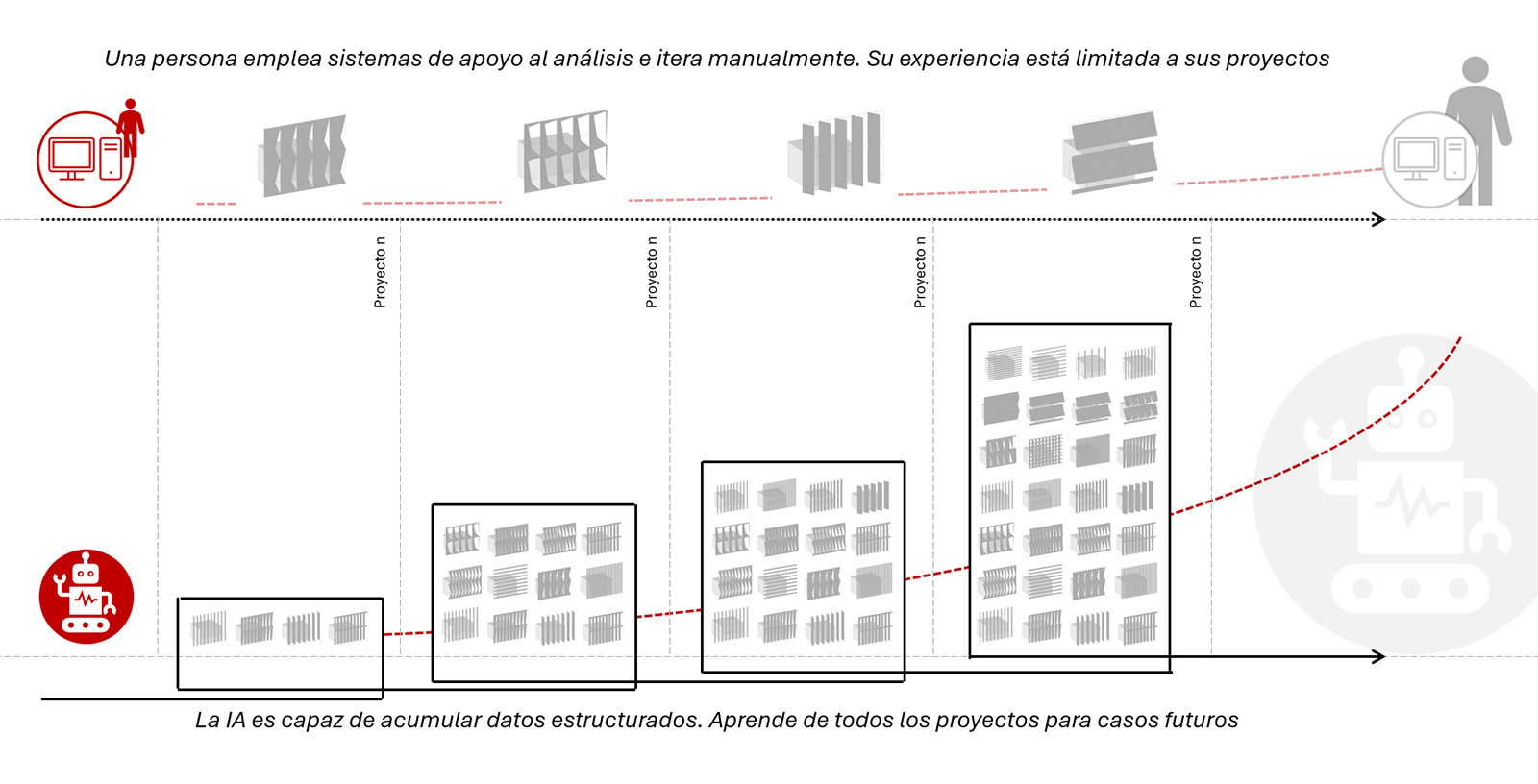
The system achieves 93% accuracy using neural networks and significantly speeds up analysis compared to traditional methods. This enables the incorporation of variables such as solar radiation and natural light from the outset, thereby improving decision-making from the earliest stages.
AI neural networks learn from examples. By analysing large volumes of data, they identify patterns and generate accurate predictions of façade performance, helping designers optimise building envelope solutions from the earliest stages.
They also significantly reduce simulation times while maintaining a high level of accuracy. Traditional design methods typically involve error margins of between 5% and 10%; in this case, the error rate was 7%, placing the results well within established industry standards. This demonstrates that the reduction in computation time has not resulted in any significant loss of reliability.
Ultimately, the aim of the research was to reduce the time currently required for performance simulations, which often makes façade analysis a slow process that is not easily integrated into the design workflow.
The result is clear: facades that respond better to their surroundings and buildings that function better from the inside out.
This line of research is part of an industrial doctoral program involving IDOM and reinforces the integration of innovation into design processes with the specific goal of improving building performance from the beginning of the design process.